What is a Performative Sentence? #
J. L. Austin writes about performative utterances as sentences which do something, in contrast with constative utterances which describe. Performative utterances are “operative” (pg. 121) and tend to begin with verbs in the first-person singular, present, indicative and active form (pg. 124).
The nature of the standard form having a first-person and present structure means that performative utterances can be commonly found in cartoons, where characters are often explicit about their thoughts and actions. The examples below are all from the episode “Lisa’s Substitute” in The Simpsons, which I partially transcribed.
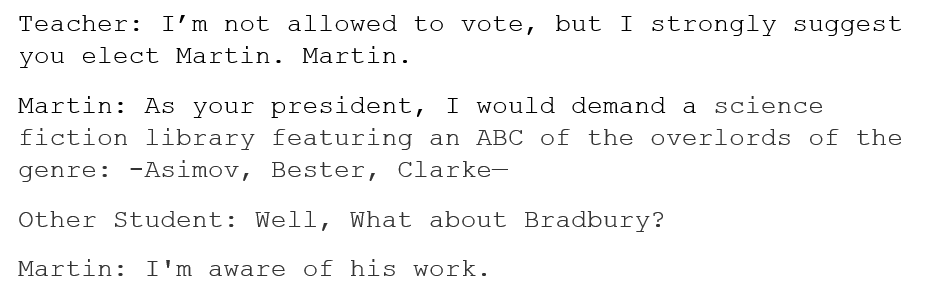
The full episode is here.
In saying that she “suggests” the class electing Martin, the teacher suggests electing Martin. The action is what Austin would consider performative – the saying is the doing, the locution is the illocution.
On the other hand, constative sentences merely describe. When Martin says that he is aware of Bradbury’s work, he is not actually aware of it only at that moment. He is describing his awareness of the work, which occurred at an earlier point in time.
It is possible to assign a truth value to constative sentences – Martin is either aware or not aware of Bradbury’s work. However, we cannot decide if “I suggest electing Martin” is true or false. We can only decide if “The teacher suggests electing Martin”, the constative version of the sentence, to be true or false.
However, Austin agrees that performative utterances should still be subject to some rules of judgement. While constative utterances can be false, the unsatisfactory versions of performative utterances are infelicitous. To be felicitous (the performative equivalent of validity), the performative act must have a conventional effect that is invoked appropriately. The act must be executed sincerely.
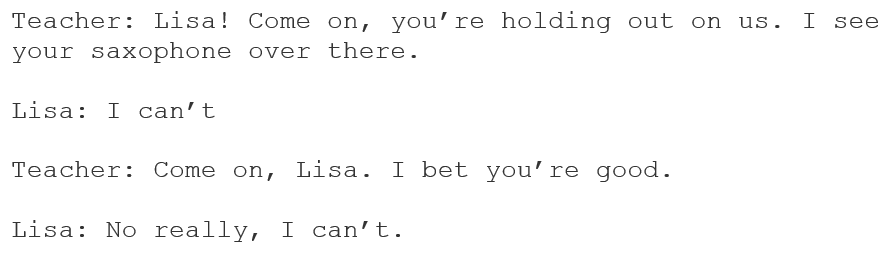
When the Lisa’s teacher asks her to show her talent, he bets the she is good at the saxophone. By tracing Austin’s standard form, we can say that bet is a performative verb. The teacher does want to make a bet when he says he bets. However, there is no actual bet because Lisa did not reciprocate in the conventional manner. That is, Lisa did not accept the bet. Furthermore, I posit that the teacher was insincere in making the bet – his real intention was for Lisa to play the saxophone for the class. Two rules laid out by Austin, the social convention of reciprocating a bet and the sincerity behind making the bet, were not met, so the performative statement of making the bet is infelicitous.
Performative Utterances and Reader Response #
Performative utterances are used in cartoons like The Simpsons to help the audience stand in the shoes of the characters. Instead of merely describing what happens in the life of the characters, performative utterances involve the audience. When the teacher uses a performative utterance to suggest the election of Martin, she is also breaking the fourth wall and making the suggestion to the viewers.
The teacher could have said non-performative variants like “I am suggesting that we elect Martin.”, which instead describes her suggestion. However, the viewers then are not the objects of the performance and are not pulled into the scene the same way the original performative act implicates them. The readers are no longer obliged to take the suggestion into consideration. In this instance of a performative utterance, the conscripting effect then lies in the involuntary involvement of the reader in the events in the cartoon.
The reader (or in this scenario viewer), having a suggestion made to him or her, has to trace through the line of thoughts to understand why the teacher is making the suggestion, and why students should elect Martin. This technique, by engaging the the readers, could help them follow the fast-forwarded life in the cartoon.
For instance, the use of the performative in demonstrating the teacher’s suggestion directs the reader to understand that perhaps the class is really not in favour of Martin being class president. The teacher made the suggestion, and like the other students in the class, the viewer barely has any time to respond before Martin steps in.
Martin steals the attention away from the performance of the suggestion and its consequent social convention, to consider the suggestion and weigh in on it. In doing so, he makes the teacher’s suggestion infelicitous to the reader. Instead of suggesting (or strongly suggesting), the teacher actually intended to convince the class to elect Martin. The reader, possibly being disgusted or confused at the stolen attention, is then compelled to view Martin’s election in a negative light.
Final Thoughts #
Austin initially wrote the paper on performatives in response to the verification movement, which proposes that every sentence is constative and can either be true or false. It is interesting that he, as suggested in the last section of the reading, later let go of the performative-constative dichotomy and instead suggested families of speech acts. Some examples are mentioned in the reading, but here is my classification of the utterances shared in this blog post.
I strongly suggest you elect Martin.
Exercitive, exercises an influence on others.
I bet you’re good.
Commissive, commits the speaker to doing something.